
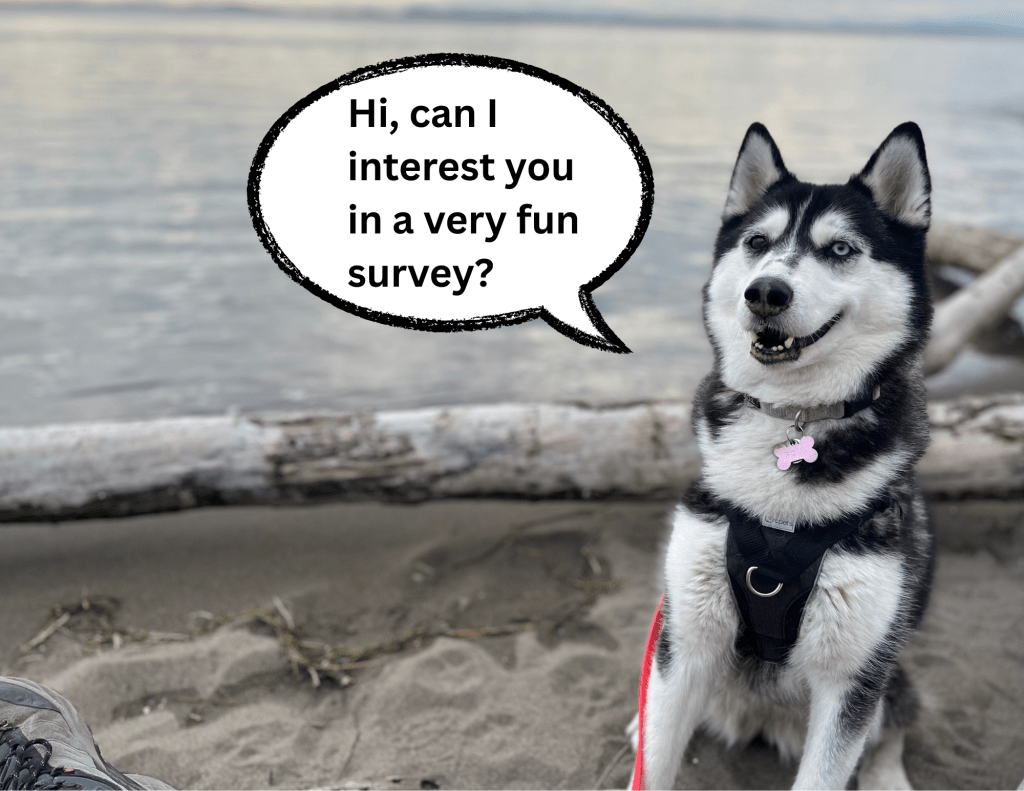
Imagine that you’ve just written an amazing survey. The questions are clear and useful. The font size is just right. You just need people to fill it in. That’s the easy part, right?
Welcome to the third, and final, blog of this series, Mistakes I’ve Made: Surveys. The goal of this series is to share some of what I’ve learned about surveys over the past couple years so you can learn from them, too. Part 1 covered phrasing and Part 2 was all about formatting.
Delivering surveys is not a neutral process. It’s important to think about how, when and where you’re inviting visitors to fill in a survey, because this context can affect their individual responses and your results overall.
Surveys can be delivered in many ways (e.g. online, via phone, etc.) but in this post I’ll focus on what it’s like to deliver surveys in person.
Location, Location, Location!
One of the first things I think about, when planning a survey, is the intercept point. This is where I will interrupt people during their visit, to invite them to fill in a survey.
You can intercept visitors in one or more places. The best intercept points will depend on the layout of the museum and the goal of the survey.
The following are five things I consider when planning where to intercept visitors:
- Pick Something
Early in my survey delivering days, I ran a survey at a museum without planning or tracking where I intercepted visitors. This meant that I was wandering around, inviting people to fill in the survey when I saw them.
After collecting some responses I realized that I was missing some key context. For example, if a visitor wrote, “my kids loved the interactive in this exhibit” I would not know which exhibit they were referring to.
These surveys were filled in by hand, so my solution was to add notes to clarify the context on each response. This worked but was labour intensive.
I was so focused on just getting responses that I did not think about what it would be like to analyse them. If I could do it all again, I would spend more time testing the survey so I could catch issues like this before it went live.
- Pick the Right Time
I once intercepted a visitor, who was at the start of their visit, with a survey asking them to reflect on their visit. They had no idea what to write, because they had just arrived.
This seems like an easy mistake to avoid but it can be hard to tell how long visitors have been on site in a large museum or sprawling historic site.
After this interaction, I started to verbally pre-screen visitors as I intercepted them. I would approach a group and ask them about their time on site. If they were nearing the end of their visit, I’d invite them to fill in the survey. If they had just arrived on site, I would tell them to come find me to do a survey before they left – and some of them actually did!

- Pick the Right Place
Think of your last visit to a museum. Was there anywhere you naturally lingered a little longer? Why was that?
Maybe you were in a gallery with plenty of comfortable seating, taking a snack break between exhibits, or waiting for a friend who was in the washroom. These places all have great intercept potential.
Places that don’t work so well are usually:
- Outdoors
- Crowded
- Lack seating
I have delivered surveys in crowded outdoor spaces that lack seating, and have noticed visitors are much less likely to respond to a survey if they’re in an uncomfortable environment (duh).
The tricky thing is balancing intercepts at the right place and the right time in the visit. Sometimes you need to intercept in a relatively uncomfortable place.
The best solution is to prepare for the environment you’ll be in. Intercept visitors near tables, counters or give them a clipboard. If you’re outdoors, create or find shady spots, wind and rain shelters. No matter where you are, create a (more) quiet survey zone, where visitors can take a bit of time to focus on their responses.
- Pick the Right Visitors
When you intercept visitors, your biases might skew the results.
In one of my first big surveys I was intercepting visitors at an exhibit. Some were chatty, some were not. I found myself gravitating towards the chatty visitors because they were friendly. Most of them would fill in the survey and that was great but I was missing out on all the not-so-chatty visitors.
The solution was to intercept visitors systematically, to minimize my bias. intercepted every third visitor who entered the exhibit. I stopped looking for friendly faces, embraced the potential for rejection and stuck to every third visitor.
Picking the right visitors is about intercepting the full range of people who are actually there – not just who looks most friendly.
- Pick a Greeting
If a stranger says “Hi, do you want to fill in a survey?” my answer is almost always “No.”
I’d argue the most critical part of any intercept is in the first few seconds. There is a tiny and precious window of time where visitors don’t know who you are, why you’re there and what you want from them. This is where you need a ‘survey pitch.’
I used to start my ‘survey pitch’ by telling visitors I was inviting them to fill in a survey – that was a mistake! If the visitors didn’t know anything about me or the survey, it was a very easy ‘No.’
Now, I start a little more conversationally. I might say something like, “Hi, I’m a researcher and I want to know what visitors think of this exhibit” or I might ask “Are you just arriving at the museum today?”. It’s a quick way to engage with visitors so they feel a little more invested in me / the survey and are a little more likely to say yes.
I’ve found it helpful to have a few greetings picked out. Some are super short, for the speedy visitors, and others are longer and more detailed. In each greeting I cover the basics of what the survey is for and how long it takes to fill in. Some visitors will still decline to fill in the survey, but it will be less than if I just asked them to fill in a survey.
Surveys are a staple in visitor studies.
They are a flexible evaluation method to help museums connect with their visitors directly. They may look simple, but can be tricky to design effectively.
The most important thing I’ve learned about surveys is to pilot as much as possible. Test questions, test layouts, test different intercepts. Make any adjustments and then get collecting responses.
If you’re interested in learning more about surveys or other methods of data collection explore more through courses, services, or email me at tara@tmvisitorstudies.com.
 TM Visitor Studies