

Imagine it is the height of summer and you are visiting a historic site on your own. It’s a sprawling space with multiple buildings, outdoor activities, and interpretive programs – and it’s really busy.
There are visitors everywhere. Kids are shouting and running past you, there’s a group of older adults who have overtaken the cafe, and a young couple is taking selfies in front of a diorama.
You pass a group of visitors speaking to each other excitedly in a language you don’t recognize as you make your way to the meeting point for the next tour. An interpreter in a historic costume steps out from a nearby building and yells “Next tour starts here in 5 minutes!”
That’s amazing. You’d never be this early to a tour if you were traveling with your own kids.
Every visitor experiences your site differently depending on who they are with. This is why understanding group composition is key to understanding your visitors.
Group composition affects:
- Where visitors go
- How long they spend
- What they do
Importantly, group composition is not just about numbers. There is a big difference between a pair of longtime friends on holiday and a parent trying to entertain their toddler. Both are groups of two individuals but their motivations for visiting and experience on site will be different.
Lately I’ve been thinking about group composition in four broad categories. There’s lots of detail within, and even some overlap between, the categories but they’re a helpful place to start thinking about how visitors experience a site differently depending on who they’re with.
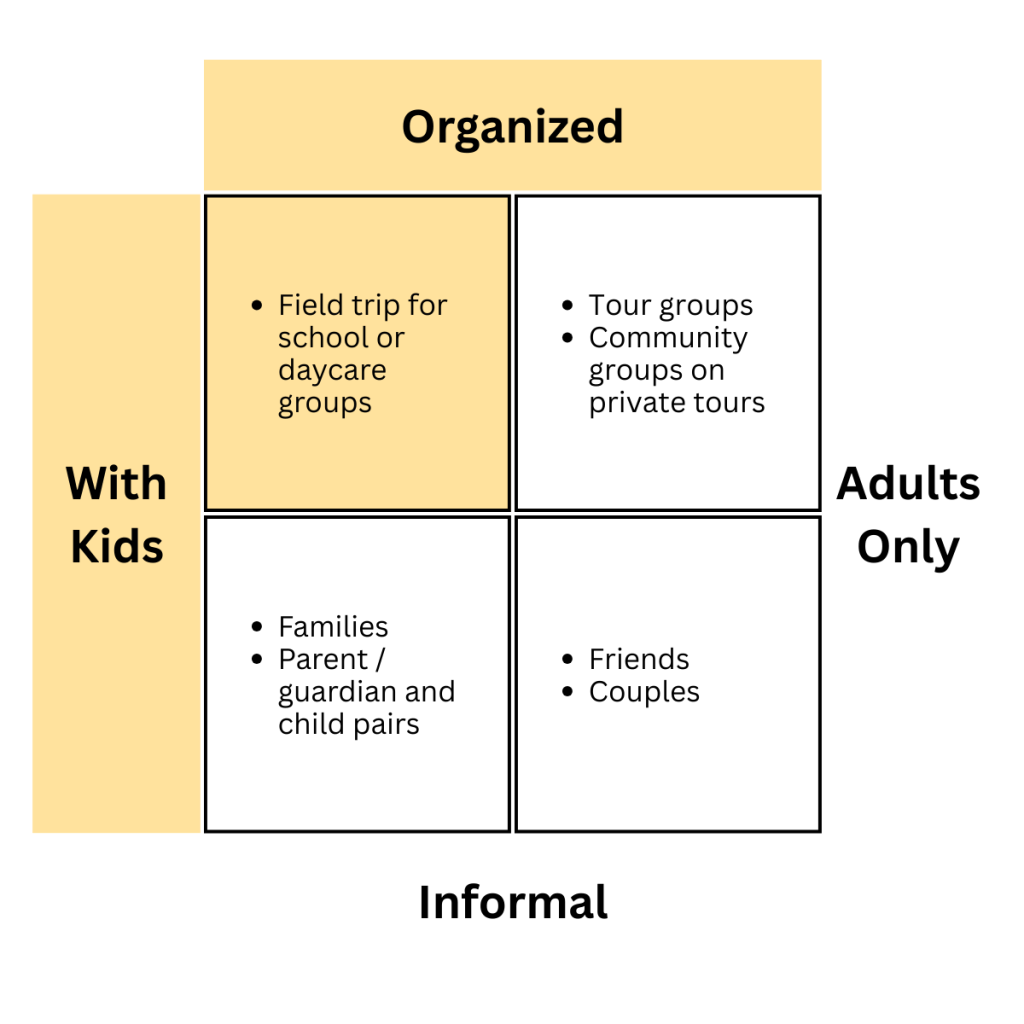
1. Organized Group with Kids
Field trips are the most distinct of all four types of group composition. These groups are often big, focused on learning, and time-bound. They’ll need bathroom breaks and snack breaks and then more bathroom breaks.
Kids can – and do – absolutely have a blast on field trips but the logistics of moving 30 or more kids through a site often mean they’re on a tight schedule with minimal time to explore freely.
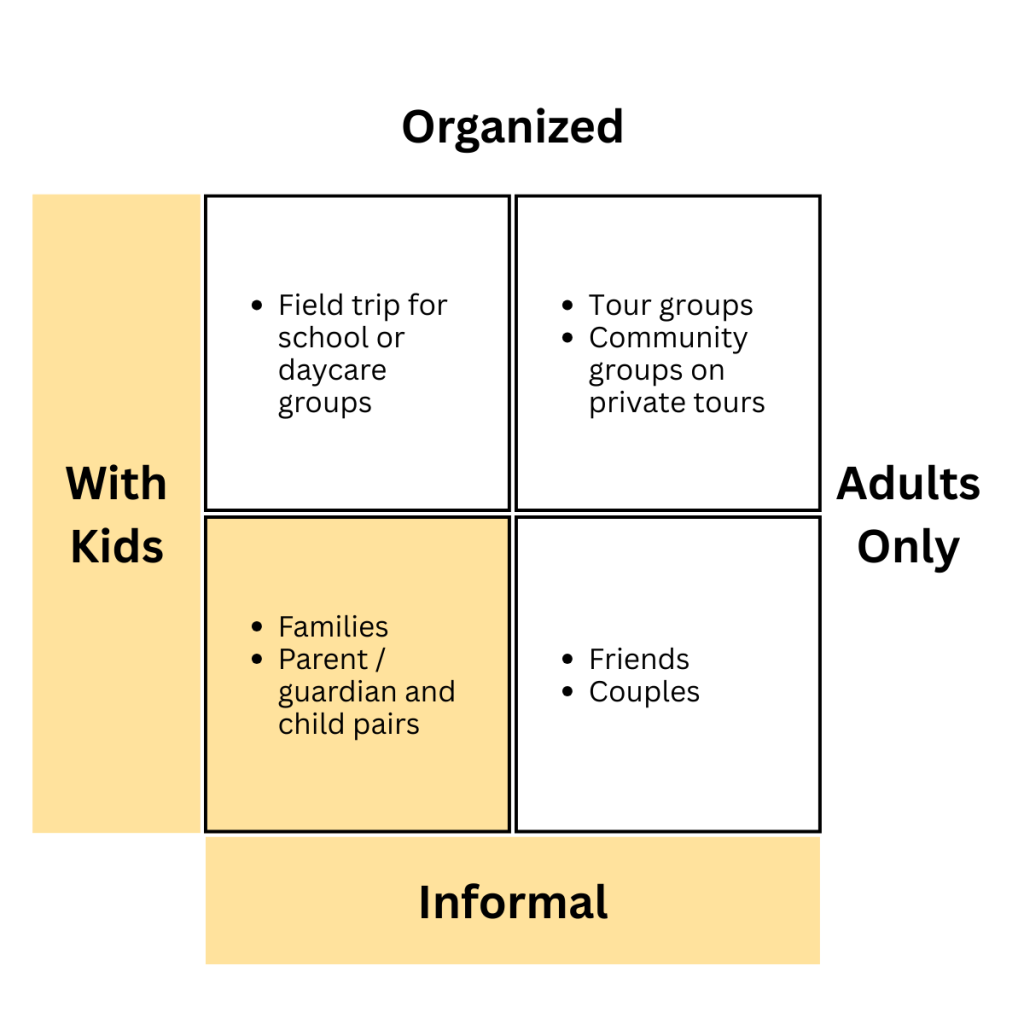
2. Informal Group with Kids
When kids get to visit a site with their family or friend group they generally have more freedom to explore what interests them. This can look like parents or caregivers letting kids lead the way through exhibits or the adults facilitating a specific learning experience for the kids. However, they can be limited by nap times, stroller accessibility, and shorter attention spans.
Kids can also encourage their group to explore more than an adult-only group would otherwise. I’ve often seen kids be the first ones to run up to a digital interactive, pull open a drawer, or ask questions about an exhibit.
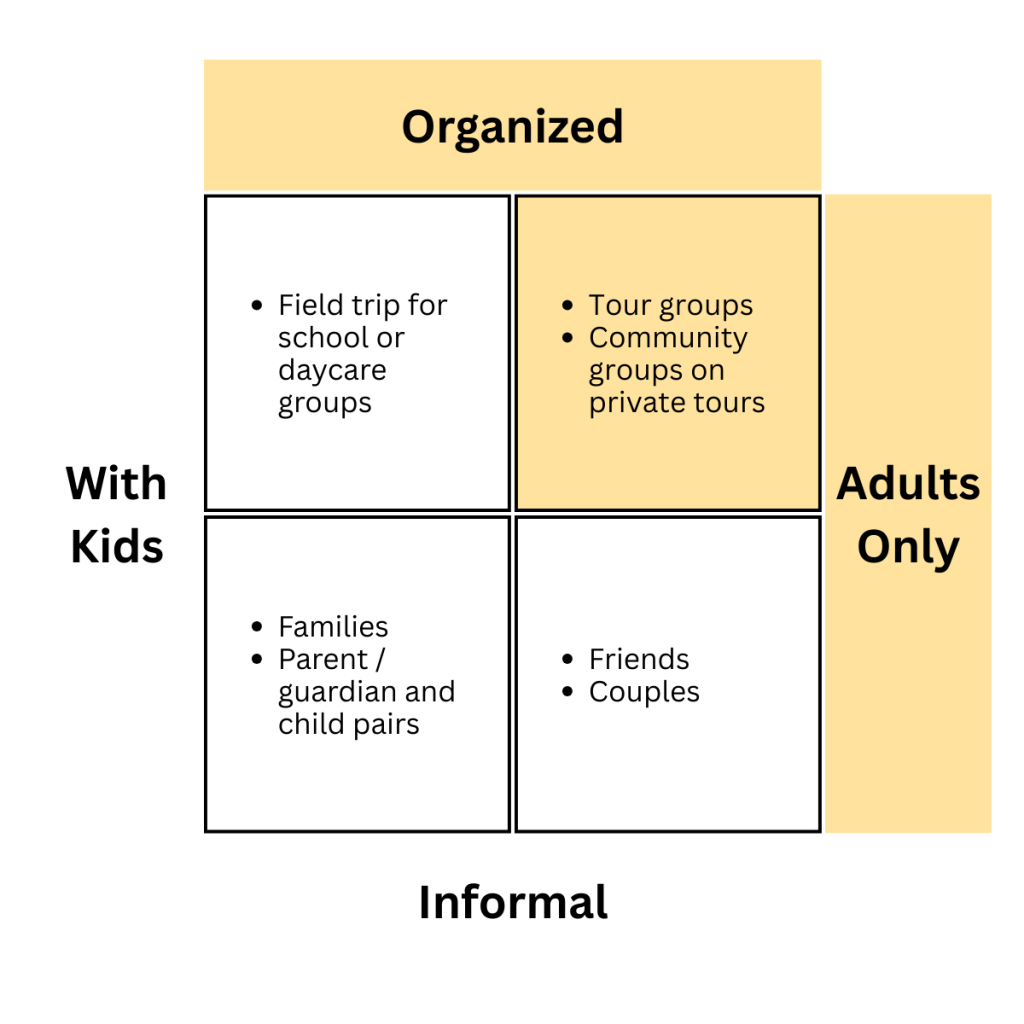
3. Organized Group with Only Adults
Adults who visit as part of an organized group are a diverse category. They could be a group of language learners from the local adult education centre, seniors from an assisted living community, or cruise tourists on a shore excursion.
Some visitors in these groups will be keen to learn and engage with the interpretation at your site and others may just be along for the ride. Similar to organized groups with kids they may have a packed schedule with limited time to explore your site beyond their group visit time but will always benefit from bathrooms and places to take breaks.
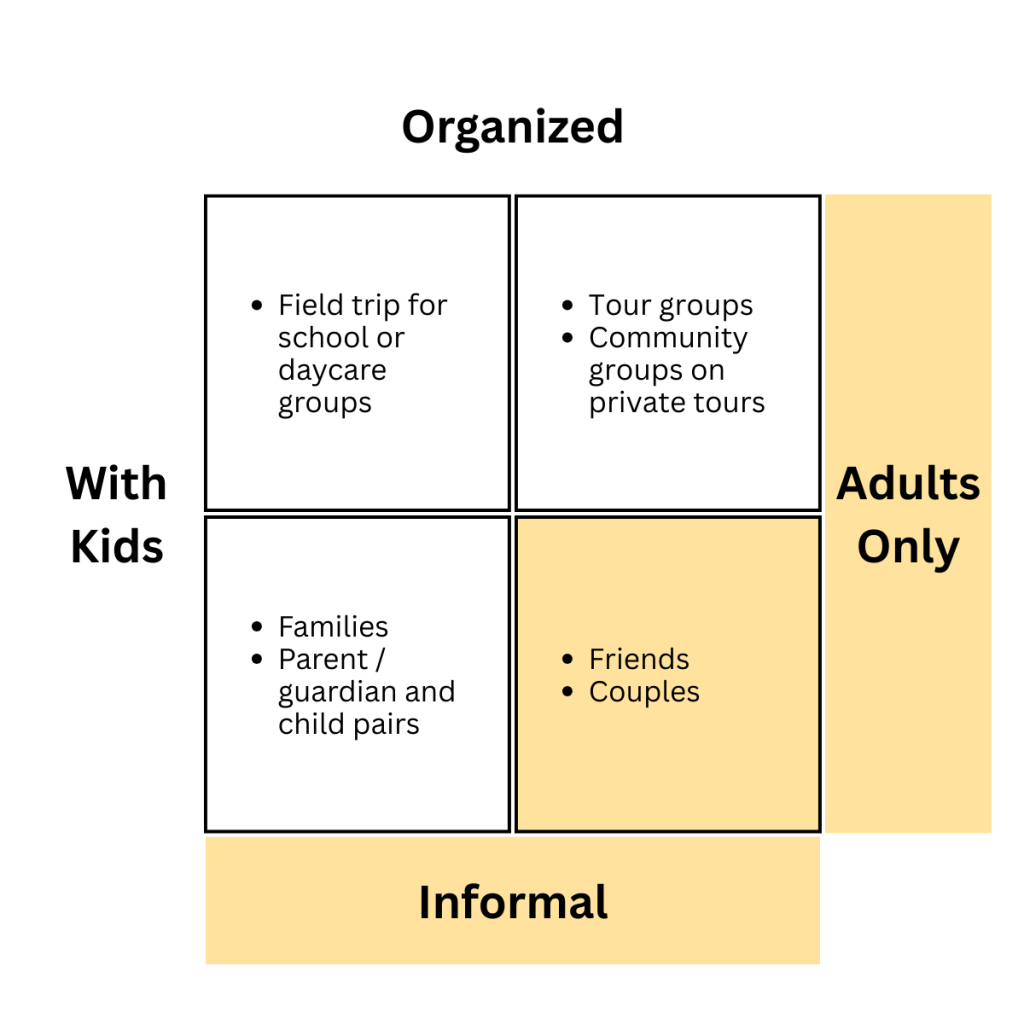
4. Informal Group with Only Adults
Adults who visit outside of an organized group usually have a broad range of motivations for visiting.
They could be tourists who are passionate about the topics covered at your site, on a girls’ weekend trip, or killing time (yes, these are all reasons I’ve seen visitors self-report for why they were visiting a museum).
In my experience, I’ve noticed these visitors tend to be the most likely to arrive together but visit independently; one may read every panel in an exhibit while another skips ahead to the next interactive.
Solo Visitors
There’s one more type of visitor that doesn’t show up in any of these categories because they’re on their own. I’d actually argue that solo visitors are just a group composed of one person. This usually means they’re more focused on the interpretation; taking as much as little time as they want to explore the site.
So, how can this help you?
Understanding different types of group composition helps you anticipate your visitors’ needs which means they can get the most out of their visit. For example, informal groups with kids may need space to park strollers and explore on their own whereas an organized group with adults only may want to book their own private tour to make the most out of limited time.
Each site has their own unique audiences. Use these four categories as a guide to start looking at the types of groups that come to your site. Maybe they match the examples here or maybe they’re different.
Build out your own categories for the different types of groups that visit your site and look for patterns. This will help you understand more about how group composition affects where your visitors go, how long they spend, and what they do.
Ready to understand your visitors more?
Learn more about how to plan simple but practical visitor studies at your site through Foundations of Visitor Studies and Analysis and Presenting the Data or reach out to schedule a free discovery call by emailing tara@tmvisitorstudies.com.
 TM Visitor Studies